Spent last weekend at the Temecula Valley Balloon and Wine Festival (http://www.tvbwf.com/) and it was fabulous! Almost 30 wineries, over 200 vendors, and 2 fantastic balloon launches both mornings.
The evenings were filled with music from both country and rock artists including James Otto, Lonestar, Chuck Wicks, Survivor and Sugar Ray. And there were also evening balloon glows set to music both nights. What could be better??
It takes over 700 volunteers to make this event happen and I am so appreciative of the efforts in making this event a success!
If you have not checked out this event yet, you need to put it on your calendar right now for the first weekend in June 2010. It will be bigger and better with a newly constructed amphitheater...woohoo!
See you there:)
The Wino Club Logo

Wednesday


Saturday
The Wino Club: Temecula Wines
Temecula wines compete with each other and some great quality was found. What I'm most excited about is the Grenache Rose, which Peter Poole of Vitis Consulting explained as a truly new experiment for this valley. This Barbie pink wine was surprisingly not sticky sweet, but well balanced, dry and crisp with beautiful color and fruit. So good in fact, it tied for first at our own Wino Club meeting!
Winners of the fourth annual Temecula Valley Wine Society Competition have been announced.
South Coast Winery’s 2007 Semillion and 2007 White Proprietary Blend “GVR” tied for Best of Class (Whites). Additionally, its Non Vintage Sparkling Syrah “Ruby Cuvee” and 2007 Genache Rose were awarded Best of Class in their respective categories.
Stuart Cellars Winery’s 2005 Meritage “Long Valley Red – Unfiltered Estate Bottled” and Thornton Winery’s 2005 Proprietary Red Blend “Cabernet/Merlot” tied for Best of Class (Reds).
The big winner, voted Best Wine overall, was Mount Palomar’s Non Vintage Solera Cream Sherry.
Article from the Valley News.
Monday
The Wino Club: Sake Making
I really have been fascinated with Sake lately and the ongoing debate that Sake is more like wine in tasting palette and like beer in the fermenting. This article from The Daily Yomuri Online explains how the fermenting is getting more and more wine-like:
Three sake brewers are using old wine barrels to age sake in attempt to stop a decline in what is regarded as the national tipple.
Sake kept in wine barrels carries slight hints of white wine in its flavor and brewers hope it will prove to be more pleasant to the palate. Although the amount produced by this unorthodox method is still small, some kinds have sold out, and its popularity is growing.
The brewers also are targeting the overseas market, riding an international boom in Japanese cuisine.
Other brewers plan to use wine barrels to age their products.
The barrels being used are of French oak and were used for making white wine by Katsunuma Winery Co, one of the leading wineries in Katsunumacho, the center of Koshu (Yamanashi) wine production in Yamanashi Prefecture.
Gochouda Brewery Co. in Ureshino, Saga Prefecture, started storing sake in the barrels in autumn 2006. Koichi Hasegawa, 52, president of Hasegawasaketen store in Koto Ward, Tokyo, acted as a mediator between the winery and the sake maker. Hasegawa, who also is a client of Katsunuma Winery, thought the mild scent of Koshu grapes would work well in sake.
Hishitomo Brewery Co. of Shimosuwamachi, Nagano Prefecture, and Sumikawa Brewery Co. of Hagi, Yamaguchi Prefecture, followed suit in April 2007.
Wine barrels are usually thrown out after five or six years of use. The sake makers select barrels used for three or four years and keep their top-quality sake in the barrels for several months.
The sake makers are still working through trial and error as the taste differs slightly according to the season and barrel conditions. "The barrels have worked well with the sake, making the most of the delicate flavors," Hasegawa said.
Japan Airlines started serving one of the wine-barrel sake brands in its first class cabins in June 2007. It has proven popular with foreign passengers, according to the airline. The sake makers plan to export the sake to the United States starting later this year with shipments to Britain and Taiwan sometime later.
The sake makers hope the sake also will go over well with younger Japanese consumers, who are more accustomed to drinking wine than older customers.
"If sake loses popularity, Japan's alcohol culture, including wine, won't grow," said Shigeyuki Hirayama, executive managing director at Katsunuma Winery Co.
The Wino Club: Russian Wine
Many articles come across my desk, but one touting the upsurge of fine Russian wines that also happen to be naturally organic intrigued me.
The problem is, I have never seen a Russian wine available to even begin to qualify this statement. Most of the wine making history of Russia consists of high regulations and the inability or means for vintners to bottle their own product. The wine is organic not because of environmental choice, but because of the lack of funds to buy pesticides. And let's face it, from what I've heard, Russia had been producing for decades wine that could hardly be called that. Not that I don't believe in second chances and a new resurgence of quality.
With that in mind, I don't see that many Russian wine makers will be able to fund the cost of marketing and shipping their products to the United States and have not heard of many importers rushing out to Russia to import. It would be most interesting to see the development of a new world product coming from this European nation. Perhaps it will take less time than English wines to make it here to the States?
Tuesday
The WIno Club: Female Winemakers Take over Spain
When I read this article in the Wall Street Journal I laughed so hard at one of the quotations from a female wine maker that I had to post it up here. It appears that female entrants into the University to study the art have increased 40% in the past few years. They have found a niche in Spain's wine world that accepts and nurtures them, but it of course is in the one region of Spain where they produce nothing but white wine, Albarino to be exact. Of course the women end up in this region over the more masculine Rioja areas right? Here's the best quotation ever:
Funny.
The article gives a great history of the region and profiles a few of the women heading up the wine making in this region. I will definitely be looking for some Albarino to taste soon - on the drier side for me with crisp lemony flavors and the minerality of the nearby ocean. I highly recommend you read the original article posted here.
Friday
The Wino Club: Cleavage Creek
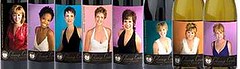
We don't typically promote one wine over any others and I have to admit that I only just ordered this wine and have not tasted it yet. But sometimes it just doesn't matter. Cleavage Creek Cellars in Napa, California, features a different survivor on every bottle of wine and donates 10% back to breast cancer issues. It's worth a taste just to know you can be socially responsible and drunk at the same time - love that!
Check out their store at http://www.cleavagecreek.com
Saturday
The Wino Club: Temecula Winery Wins
People in Northern California laugh at our claims of having a wine country in Southern California. Even though we have a good number of active wineries here, they snub their noses at the quality of our wines. And to be honest, they used to be correct. Used to be. Our vintners here have been working on not only the quality of product but on the perception that we are a sub-prime wine growing / producing region.
Our sincerest congratulations goes out to Jim & Maggie Carter for the preponderance of awards issued to them and mostly for kicking some Northern California butt at their own competition. Here's the article:
Vindicated at last: Temecula winery takes top honors at California State Fair
10:00 PM PDT on Friday, July 11, 2008
A Temecula-area winery took home top honors from the California State Fair this week, winning a trophy as the statewide competition's premier winery and capturing almost 40 medals.
South Coast Winery won the 2008 Golden State Winery of the Year honor at the fair's Commercial Wine Competition, fair officials announced Friday. It is the first time a Southern California winery has won the award.
The winery beat out 647 others for the trophy. The competition took place last month in Sacramento.
The Golden State Winery honor recognizes the winery that wins a significant number of the highest-level awards.
South Coast's wines won seven gold medals, 13 silver medals, four bronze medals, 12 Best of Class honors and one Best of Region award. Twenty-three of the 36 wines South Coast entered won a medal.
"There's only a handful of wineries that enter that many and do that well," said Mike Bradley, chief bureau of exhibits for the fair.
About 2,900 wines were entered in the competition, which fair officials say is the oldest in North America. The first competition took place in 1855.
South Coast Winery owner Jim Carter said the win was unexpected but proves the winery's commitment to quality.
"We're on the right track," he said. "We're producing wines that Southern California can be proud of.
"It shows the grapes we have here in Temecula are equal to the grapes in other areas of our state."
Opened four years ago, South Coast is one of the region's larger wineries, manufacturing about 60,000 cases of wine a year. South Coast also has a resort and day spa.
Ray Falkner, president of the Temecula Valley Winegrowers Association, said the award is a "great boon for our entire region.
"This really ... gets a lot of wine writers and distributors and aficionados to pay attention to our region," he said.
With about 30 wineries, Wine Country is small compared with its counterparts in better-known regions in Central and Northern California.
The region's wines have suffered from a poor reputation in the past, but Temecula winemakers have banded together to improve quality. They have entered competitions and invited wine critics to Temecula to taste their product.
Reach Jeff Horseman at 951-375-3727 or jhorseman@PE.com
ttp://www.pe.com/localnews/rivcounty/stories/PE_News_Local_S_swine12.47fcd6f.html
Monday
Calories in Wine: Wine News
The ever-so-helpful folks at the Consumer Federation of America have come up with an Alcohol Facts Poster that compares all kinds of alcoholic beverages based on alcohol content, calories and carbs. The poster analyzes the 26 top-selling domestic and imported alcohol brands, from good ol’ Bud Light to Beringer Chardonnay.
And why, pray tell, would the consumer group do this? Well, it’s lobbying in Washington D.C. for a government-mandated “standardized and complete alcohol label” to be slapped on every bottle of alcoholic beverages, according to the federation’s press release.
The alcohol info is also “designed to help consumers follow the Dietary Guidelines’ advice that men limit their consumption to two drinks a day and that women restrict their consumption to one drink per day,” the news release says. And I don’t know about you, but I live my life according to the federal government’s dietary guidelines. Don’t you? Doesn’t everyone?
Anyway, here’s a quote from the release:
“Right now, consumers really have no way of knowing the most basic information about alcoholic beverages,” said Chris Waldrop, Director of the Food Policy Institute at the Consumer Federation of America. “It’s time to end the confusion so consumers can make informed and responsible purchasing and consumption decisions. We’re making information available today on some of the top selling brands, but the federal government needs to require standardized and complete alcohol labeling on all alcoholic beverages.”
While I’ve never really monitored my carbohydrates intake beyond watching them go into my mouth, it was a bit surprising to see the difference in carbs between one serving of chardonnay (0.8 grams) and cabernet (5.0 grams). Perhaps I’ll put that on my list of things to worry about someday.
What do you think of this report, and the factors behind it?
http://www.daytondailynews.com/blogs/content/shared-gen/blogs/dayton/wine/entries/2008/07/07/cutting_carbs_f.html
Thursday
French Winemakers Lose Their Status
When I saw this article I just started to laugh. I love French wines but I also know that many of the premium classifications are decades, sometimes centuries old so I don't give it much heed. I am also not a collector - I am a drinker. Paying $30 more per bottle because it is a Classe A makes no sense to me then the Nin du Pays (Country Wine literally) is similar in flavor and a fraction of the price. So I LOVE that St. Emilion is eliminating the rankings. It means more affordable wines for all and a more balanced approach to newer wineries who can sometimes produce a better wine than the centuries old pedigreed wines. BORDEAUX, France (AFP) - "Just as we are about to start putting the 2006 vintage into bottles, we have to cancel all the labels and all the cases and re-do them," said Christine Valette, owner of Chateau Troplong-Mondot, recently awarded the second highest rank of St Emilion Premier Grand Cru Classe. "I am in shock. The team at the chateau is in shock. I never imagined this could happen," added Valette, who said she has spent the last 20 years working toward winning the prized title. The ranking, which applies only to the St Emilion region and is reassessed every 10 years, consists of three classifications -- Premier Grand Cru Classe A, Premier Grand Cru Classe B and Grand Cru Classe. The court said it was cancelling the St Emilion classification because it believed the system used to rank the wines after a tasting was not fully impartial. The A category has only ever been awarded to two chateaux, the much sought after wines of Ausone and Cheval Blanc, while examples from the B category include chateaux Angelus, Clos Fourtet and Troplong Mondot. The rankings are estimated to boost the price of the wine by about 30 percent, and thus also affect property prices. A spokesperson for the St Emilion Wine Union (Conseil des Vins de St Emilion) described the situation as "serious." The Union is awaiting a decision from INAO (Institut National des Appellations d'Origine), the government body that manages French wine classifications, and the French Agriculture Minister as to whether they will appeal the ruling within the allowed time period of two months. But legal sources said an appeals process could take up to two years. For many in Bordeaux however the situation without the St Emilion classification system would be impossible. "The whole situation is ... idiotic and absurd, they can't stop the 60 or more chateaux that have the rankings from using them," said Jean Baptiste Bourotte of Audy, a Bordeaux wine merchant who had just heard the news. "I don't see how we could sell the wine."
Collectors should rush out right now and pick up the last of the fancy stuff before its gone! But remember,just because the label is gone doesn't mean the insides of the bottles are any less delicious.
The Wino Club News: Wine Makers Riot in France
Here are some wine growers who take their business seriously. The economy may be tough, but rioting wine makers gets our award for peculiar news. 
 Wine growers throw stones at riot police after a demonstration in Montpellier, southern France Wednesday, June 25, 2008. THE ASSOCIATED PRESS/Claude Paris |
MONTPELLIER, France - Winemakers in southern France have burned two police cars and vandalized supermarkets during protests to demand government aid.
Vintners in France's Languedoc-Roussillon region have been protesting plummeting prices for their regional wines as well as rising fuel costs.
Top regional official Cyrille Schott says protesters broke windows at the courthouse in the city of Montpellier. In nearby Montagnac, protesters wielding baseball bats chased police from their vehicles and set the cars on fire.
Schott says protesters damaged four bank buildings.http://cnews.canoe.ca/CNEWS/World/2008/06/26/5993016-ap.html
Wednesday
Wine and Music Pairing
So just in case food and wine pairing hadn't gotten too complicated, now we have to pair the wine with music too? What happened to just drinking? This article was from the BBC:
| |
Playing a certain type of music can enhance the way wine tastes, research by psychologists suggests.
The Heriot Watt University study found people rated the change in taste by up to 60% depending on the melody heard.
The researchers said cabernet sauvignon was most affected by "powerful and heavy" music, and chardonnay by "zingy and refreshing" sounds.
Professor Adrian North said the study could lead retailers to put music recommendations on their wine bottles.
The research involved 250 students at the university who were offered a free glass of wine in exchange for their views.
Brain theory
Four types of music were played - Carmina Burana by Orff ("powerful and heavy"), Waltz of the Flowers from The Nutcracker by Tchaikovsky ("subtle and refined"), Just Can't Get Enough by Nouvelle Vague ("zingy and refreshing") and Slow Breakdown by Michael Brook ("mellow and soft")
The white wine was rated 40% more zingy and refreshing when that music was played, but only 26% more mellow and soft when music in that category was heard.
 | MUSIC RECOMMENDATIONS Cabernet Sauvignon: All Along The Watchtower (Jimi Hendrix), Honky Tonk Woman (Rolling Stones), Live And Let Die (Paul McCartney and Wings), Won't Get Fooled Again (The Who) Chardonnay: Atomic (Blondie), Rock DJ (Robbie Williams), What's Love Got To Do With It (Tina Turner), Spinning Around (Kylie Minogue) Syrah: Nessun Dorma (Puccini), Orinoco Flow (Enya), Chariots Of Fire (Vangelis), Canon (Johann Pachelbel) Merlot: Sitting On The Dock Of The Bay (Otis Redding), Easy (Lionel Ritchie), Over The Rainbow (Eva Cassidy), Heartbeats (Jose Gonzalez) Source: Montes wines |
The red was altered 25% by mellow and fresh music, yet 60% by powerful and heavy music.
The results were put down to "cognitive priming theory", where the music sets up the brain to respond to the wine in a certain way.
"Wine manufacturers could recommend that while drinking a certain wine, you should listen to a certain sort of music," Prof North said.
The research was carried out for Chilean winemaker Aurelio Montes, who plays monastic chants to his maturing wines.
Mr Montes said: "It was therefore a natural extension to link with Heriot Watt and to scientifically determine the impact that music has on how wine tastes."
Previously, Professor North conducted supermarket research which suggested people were five times more likely to buy French wine than German wine if accordion music was played in the background.
If an oompah band was played, the German product outsold the French by two to one.Their story came from here: http://news.bbc.co.uk/2/hi/uk_news/7400109.stm
Thursday
The Wino Club: Pinot Noir for Diabetics
Looks like people can be part of the Wino Club and be healed at the same time! According to this medical study, Pinot Noir can have some positive effects on sufferers of Diabetes. I just want to know if I can sign up to be a part of a drinking-based study.
Friday
The Wino Club In Entrepreneur Magazine

We've been busy here at The Wino Club... see us in the November issue of Entrepreneur Magazine. There's a great picture of us in the print article so check it out but we've included it here just so those readers who are more digitally inclined can enjoy the whole experience - it is a darn good picture and we wouldn't want anyone to miss it.
To read the article on line, click here: The Wino Club in Entrepreneur Magazine.
In the next couple of weeks we will be posting a TV interview we did on KZSW as well. Told you we've been busy!
Wine Tasting: Grenache Grows Up
We're taking a detour in our wine tasting at The Wino Club in November from talking about Rhone wines to jumping into Grenache. Now the departure is not a great one, since all Rhone wines contain some Grenache, sometimes up to 80%. However, Rhone wines tend to look at this grape as a blender, used to either compliment other varietals or if alone as a nice dry rose.
We have another opinion. Grenache is bold and strong without overpowering the palette. It has enough to sink your teeth into without hitting you over the head. Grenache is so much more than a blending wine and is our new favorite stand-alone varietal - sorry Red Zinfandel.
It all happened by lucky accident and a bargain shopping find. Our personal Wino Club was doing a special tasting of wines of Australia with specific instructions to avoid the traditional Shiraz. I was searching for my pick when I came across a store that was closing and everything inside was half off, including the wine. You don't have to tell me twice! I had a shopping cart filled up in no time. There was one bottle I picked up just because it made me laugh and it was inexpensive enough to buy as a joke ($5 on sale). It is a wine called Bi@#h (I'm not spelling it out because it's not a nice word). It had a pretty pink label and looked novelty for sure. It also happened to hail from Australia and incidentally was 100% Grenache.
Well this little wine went up against 13 bottles worth $17 and up and won. And not just won but was the first wine ever to be voted for nearly unanimously by all 15 women in attendance, all of whom have very different palettes. We were onto something.
Grenache happens to be the most widely planted grape varietal in the world. It is low in tannins and pale in color with a nice soft pinkish-purple hue. If picked early it is used to make rose wines. If allowed to ripen slowly in a hot and dry terrain then it turns into a soft yet spicy wine with a relatively high alcohol content of around 15% competing against Red Zinfandel. Yet unlike Zinfandel, found only in California where oak prevails, Grenache originated in Spain and then moved to be a major grape in France, Australia and yes, California as well.
As a stand alone wine it is full bodied, juicy and earthy. It has a beautiful berry jam start with nice heat and earthiness on the back end. As a blending wine, it offers a backbone to harsher varietals, lending low acid and low tannis for balance.
Wine Tasting: Grenache Tasting Tips
Look for the following flavors or scents when tasting Grenache:
Earth Warm Flesh Dried Apricot Vanilla Sweet Wood
Blackberry Smoke Toast Tobacco Cherry Raisin
Menthol Blueberry Boysenberry Plum
Monday
Wine Tasting: Super Tuscan or Chianti?
I admit it. Chianti brings to mind straw covered bottles with dripping wax candles glowing in them on a table covered with a red checkered cloth. Right? It is not a quality wine that comes to mind. That's not to say that there aren't some fine Chiantis now, but is there a difference between a Chianti and a Super Tuscan?
Chianti has a very interesting history, moving from the bastardized blend of red and white grapes in the 1970's into a wine made almost entirely from Sangiovese, changing the laws requiring white grapes to be used in the Chianti formula. The new laws provide a 15% blend of red grapes outside of Sangiovese. It is still a struggle by wine makers to decide whether to label their blend wines as a Super Tuscan or a Chianti.
Super Tuscans really do try to appeal to a more International palette. They tend to be big, bold and have a new oak flavor. These wines are not 'drink with spaghetti' style wines. They are not even what I would peg as an old world flavor due to their lack of subtlety. However a good Super Tuscan can be a great blend that I personally love sipping on when the evenings just start to turn crisp.
A traditional Chianti is meant for eating. True to the Italian lifestyle, this wine lends itself to food, thus it's drinkability and reputation as a spaghetti wine. It is high in acid, balancing out the tomato sauce, and low on tannins. It is actually compared more with a Pinot Noir than a Cabernet Sauvignon.
The blends are about the same for both wines so I guess your preference really comes down to what you need your wine to function as. If you're sitting around drinking with friends, reach for the Super Tuscan. If it's a family dinner with wine, pull out a Chianti. Either way, I don't think you'll be disappointed. Some of the Chianti's even come in the straw bottles if you're so inclined.
Wine Tasting for A Cause
Buy The Wino Club Party Kit today and a portion of the proceeds will go directly to Michelle's Place, a breast cancer resource center supporting women under 40 so often ignored in the fight against breast cancer.
Go to The Wino Club for your kit today and help save a life!
Sangiovese Wine Tasting Tips
Sangiovese wine is all about tasting the rustic and savory flavors of earth. Look for the following flavors or scents when tasting Sangiovese:
Tuesday
Buy Wine Now
I was reading the local paper and there was an article in the finance section entitled "Autumn Bargains". I love shopping. I can spend all day looking through stores so the name of the article was the first thing to entice me. What intrigued me further though was that the author, Marshall Loeb, took the art of shopping to a new level.
Shopping is a cyclical sport. For instance, in Southern California, buyers send us fall clothes in August when it is 100 degrees outside - like a nice wool sweater looks even remotely tempting. However, all of the cute summer clothes go on clearance and we can still wear them for several months. Makes sense right? That's the premise of the article.
In a nut shell, September is a great time to buy cars, holiday airfare and, yes WINE. The reasoning for the wine went :
"Last year's harvest begins arriving in stores in September. Because of the surplus of vino, winemakers face heavy competition and bottles tend to be priced to sell"Intrigued, I found that BevMo has started their 5 cent sale and my local wine shops also seem to have some bargains. I don't know if I will remember the cycle next year, but I am excited that October is a great month to buy jeans and November to buy sneakers and wedding gowns.
It was an odd little article but it comes down to this - look around at your favorite wine stores right now and it's possible that you might find some bargains. I wonder if there's a tequila or beer season too?
Thursday
Wine Tasting: Wine Fights Kidney Cancer
Wine tasters everywhere rejoice when reports come out about the fabulous health benefits of drinking wine. I am no exception. Darcy and I are both very involved in the fight against cancer and spend a good deal of time volunteering for various cancer organizations. In fact, part of the proceeds from the sale of The Wino Clubtm Wine Tasting Party Kit go directly to Michelle's Place, a breast cancer resource center helping women under 40 who are otherwise ignored in the fight against breast cancer.
That said, we are especially aware of any reports we find correlating the benefits of wine in relation to cancer. We've determined in our most non-scientific way that wine is cancer fighting gold and you should consume as much as possible of it.
According to the British Journal of Cancer: STOCKHOLM, Sweden, Aug. 25 Drinking wine or beer may reduce the risk of kidney cancer, a Swedish study found.
So go ahead. Drink up. O.K., 22 oz a week isn't a full weekend of debauchery, but it's a good start! We figure that if at 22oz a week our odds are 60%, then if we drink more the odds of getting cancer, at least of the kidney variety, go down proportionally. Makes perfect sense to us.
Researchers at the Karolinska Institute in Stockholm surveyed 855 kidney cancer patients and a control group of 1,204 people, The Local reported. The study found that people who drink 22 ounces of alcohol a week are 40 percent less likely to develop kidney cancer.
Professor Alicja Wolk said consuming at least two glasses of red wine each week -- or the equivalent of white wine or beer -- appears to have a beneficial effect.


